
Overview
Objective:
Develop and optimize a blower system for the new Epic12 Air curtain. The airflow solution must support multiple unit lengths while balancing airflow performance, uniformity, ground velocity, electrical efficiency, motor loading, and product performance reliability.
Customer:
Schwank
Application:
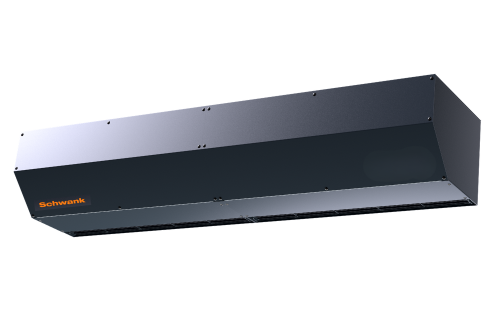
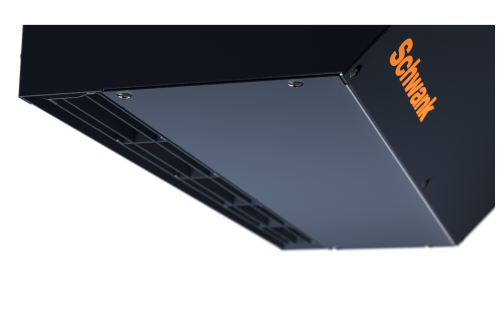
Epic12 Air Curtain (new design)
Revcor’s Role:
Engineering partner for airflow system development.
Challenge
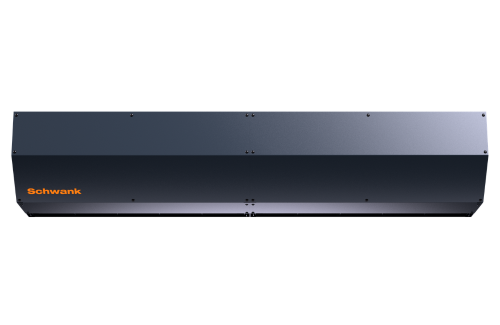
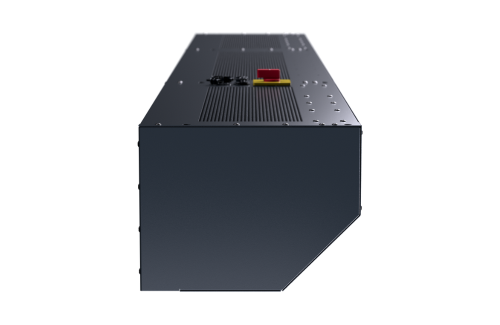
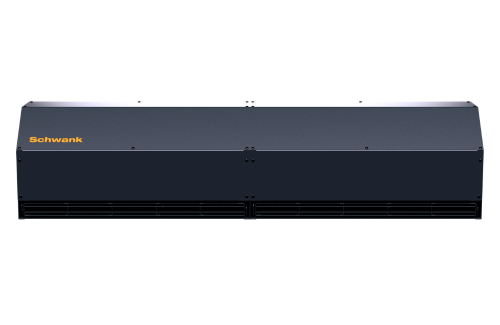
Schwank was developing the Epic12 Air Curtain as a new industrial platform designed to deliver reliable airflow performance, application flexibility, and strong value across a wide range of North American industrial doors.
To support this development, Schwank needed a blower solution capable of delivering strong, uniform airflow, acceptable electrical performance and a suitable sound profile across multiple unit lengths.
For the 36-inch model, the performance target was to achieve a minimum airflow of 1,500 CFM while keeping current draw at or below 3.7 amps at 208V. Early internal testing with sample blower wheels came close to the required targets, but airflow performance was suboptimal and sound levels were higher than desired.
To finalize the design, Schwank partnered with REVCOR’s engineering team to evaluate and optimize the Epic12 blowers at Revcor’s lab using AMCA methods. The objective was to create a solution that:
- Met the required airflow target
- Didn’t overload the motor
- Didn’t exceed acceptable sound limits
- Supported a scalable design approach for the broader Epic12 product family
Approach
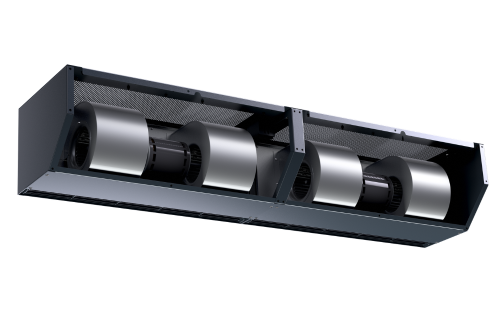
REVCOR’s engineering team conducted a detailed airflow performance evaluation using its test facility to identify the optimal blower wheel and housing configuration for the Epic12 Air Curtain platform. Rather than treating the blower as a standalone component, the team evaluated how the wheel, housing, motor load, and air curtain inlet conditions worked together as a complete system.
Using AMCA test methods, REVCOR measured airflow, air velocity, uniformity, pressure, and motor power rating across multiple prototype blower wheel configurations. The lab setup allowed the team to quickly test and compare several blower diameters, wheel designs, and housing geometries under controlled conditions, helping both teams understand how each design change affected airflow, efficiency, motor loading, and sound performance.
During testing, REVCOR also identified that the unit’s inlet design could be improved and optimized to reduce airflow restrictions, confirming that system-level airflow optimization would be critical to achieving the desired performance targets.
This lab-driven approach provided Schwank with clear performance data and allowed both teams to make informed design decisions.
Working with REVCOR gave us the development support we needed to optimize airflow for our newest Epic12 Series industrial air curtain. Their collaboration helped us move faster, validate performance, and bring a stronger solution to market.
— Sami Aslam, Product Manager Air Movement, Schwank
Results
REVCOR developed a blower solution specifically optimized for Schwank’s Epic12 Air Curtain platform, meeting the 36-inch model’s target performance of more than 1,500 CFM with power draw less than 3.7Amps.
Alternative test configurations showed that higher airflow was achievable but often required increased current draw. This confirmed the selected blower configuration as the best overall balance of airflow performance, electrical efficiency, motor loading, and sound performance for the Epic12 design.
REVCOR shared additional design recommendations with Schwank that could further increase airflow performance while supporting the long-term development of the Epic12 platform.
Through this collaborative engineering effort, Schwank achieved its Epic12 airflow target while preserving the compact product footprint and optimized power consumption required for the platform.
From airflow configuration and design support through full production, REVCOR helps OEMs turn airflow targets into validated product solutions.
Ready for your next project?
Our design engineers are ready to support you.